Britain's 10 hardest driving test centres
The ten test centres where learners are least likely to pass, and what to do if your test is at one.
Megan Watkins, Drivepal Founder·Updated 14 October 2026
Wolverhampton has had the lowest pass rate in Britain for three years running, and has been in the bottom ten for eight. Together, these ten centres have a pass rate of 37%, compared with 50% across Britain.
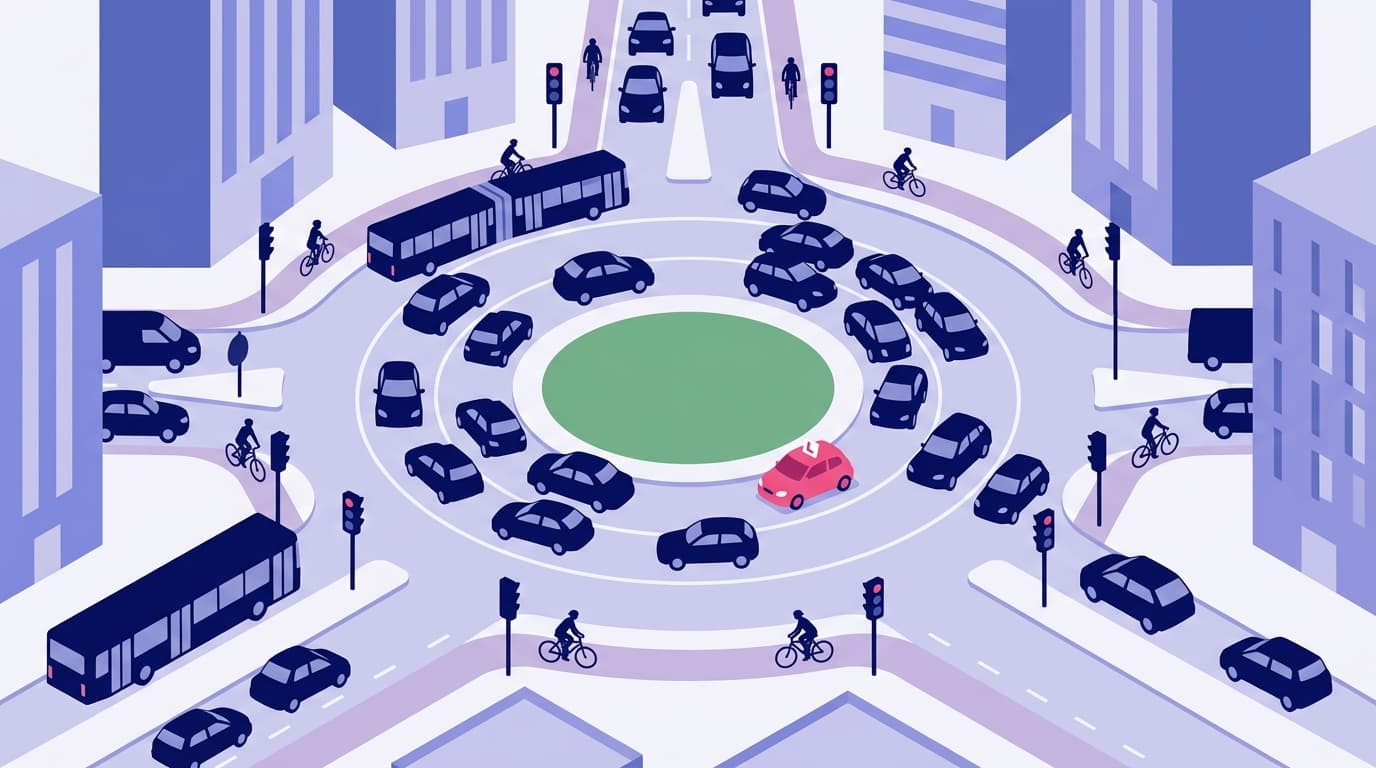
Nearly all of them are in or near big cities. Every examiner marks to the same standard, so the difference is most likely the roads. A city test packs more into the same 40 minutes.
The ten hardest
Their pass rates run from 34% at Wolverhampton to 40% at Glasgow Shieldhall.
| # | Test centre | Tests in 2025 to 2026 | Pass rate |
|---|---|---|---|
| 1 | West Midlands | 11,561 | 34.3% |
| 2 | West Midlands | 7,508 | 35.0% |
| 3 | London | 5,543 | 36.3% |
| 4 | Scotland | 5,529 | 36.4% |
| 5 | West Midlands | 13,193 | 36.4% |
| 6 | North East | 9,512 | 37.5% |
| 7 | North West | 13,472 | 37.8% |
| 8 | East of England | 7,759 | 39.2% |
| 9 | London | 13,120 | 39.9% |
| 10 | Scotland | 7,019 | 39.9% |
Lowest pass rate first. Only centres that ran at least 500 tests in the 12 months to March 2026, so no figure rests on a handful of results.
You don't have to be a worse driver to pick up a serious fault, just have more chances to.
The same names every year
DVSA's figures for each centre go back 19 years, to 2007. Wednesbury has been in the bottom ten in 11 of them. Barking Tanner Street has been there in 9. This year, Dunfermline Vine is the only newcomer.
Britain's pass rate went from 49% the year before to 50%, its highest since 2007. These ten centres stayed at 37%, so the gap between them and everywhere else got a little wider.
Why these centres are hard
Here's what a city test asks of you that a country one mostly doesn't.
- Big junctions: you'll meet roundabouts with four or five lanes, traffic lights with filter arrows, box junctions and one-way systems. Each one needs you in the correct lane early.
- Bus lanes and local rules: part-time bus lanes, contraflow lanes, and signs you might only ever see in that one town. You have to spot them in time to act on them.
- Cyclists and pedestrians: cyclists come up the inside, and people step out between parked cars. You have to see them and react, and the examiner is watching you do both.
- Less time to think: a test on quiet country roads might have a few tricky moments. In a city, you can have that many in the first few minutes.
If your test is at one of these centres
A low pass rate can feel like bad news if your test is there. It's about the roads, not about you, and roads can be learned.
- Learn the roads around the centre: the pass rate is an average of everyone who tested there. If you know the roads, you'll likely do better than it suggests.
- Look at the centres nearby: most cities have two or three centres a short drive apart, and their pass rates can be quite different. Your instructor may already know the routes there. You can compare the centres near you on our map and table of every test centre's pass rate.
- Don't go far: country centres have higher pass rates, but most people who pass there have driven those roads for months. On roads you've never driven, you don't have that.
In the weeks before your test, ask your instructor to take you round the roads near the centre.
Frequently asked questions
What's the hardest driving test centre in Britain?
Of the centres that ran at least 500 tests in the 12 months to March 2026, Wolverhampton had the lowest pass rate, at 34%. It's been the lowest for three years running, and in the bottom ten for eight: see the same names every year.
What's the hardest driving test centre in London?
Barking Tanner Street, with a pass rate of 36% in the 12 months to March 2026. That's the lowest of London's centres that ran at least 500 tests.
Are examiners stricter at these centres?
No. Every examiner marks to the same standard, and DVSA trains and checks them all against it, wherever they work. Nothing in the figures suggests examiners at these centres mark harder. It's the roads that are different.
Can I move my test to a different centre?
Yes. You can change the centre as well as the date and time. DVSA sets how many changes you get and how much notice you need, and you make the change on gov.uk/change-driving-test.
Or see the other end of the table: Britain's 10 easiest driving test centres.
How we worked this out
Everything here comes from DVSA's statistics for practical car tests at every test centre in Great Britain, for the 12 months from April 2025 to March 2026. DVSA calls this its 2025-26 financial year.
A centre's pass rate is the tests passed there in the year divided by the tests taken. The pass rates for men and women are worked out the same way. We don't adjust or smooth anything.
The rankings leave out centres that ran fewer than 500 tests in the year, because at a handful of tests one good or bad month can swing a pass rate a long way. Northern Ireland isn't included: its tests are run by a different agency, the DVA, which publishes its own figures.
DVSA doesn't publish figures by region, so we put each centre in its region from its postcode. A region's pass rate is all its passes divided by all its tests, the same way as for Britain as a whole.
Source: DVSA: Car driving test data by test centre. Released under the Open Government Licence v3.0.
Questions or corrections? info@usedrivepal.com
More from Drivepal
Driving test waiting times across Britain
How long learners are waiting across Britain, and where a shorter wait is half an hour away.

Driving test pass rates by test centre
The pass rate and typical wait at every test centre in Great Britain.

Britain's 10 easiest driving test centres
The ten centres with the highest pass rates, and whether it's worth travelling to one.
The most common driving test faults
The ten most common driving test faults, and what to practise before your test.
For Press
Journalists & researchers
All Drivepal research is free to cite, quote, or reference with attribution. Each report includes a methodology section and links to source data.
Press enquiries: info@usedrivepal.com